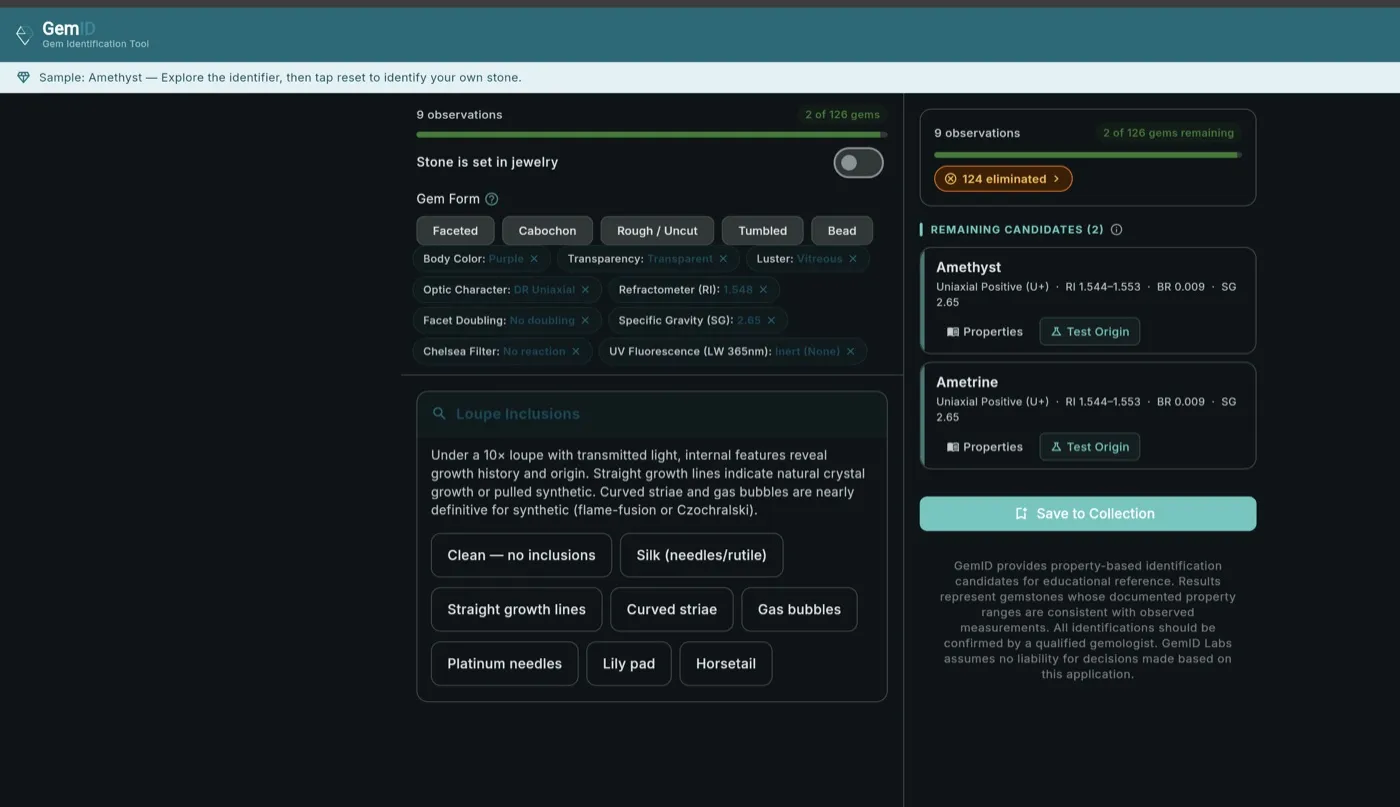
Identify gemstones the way a gemologist does — by measuring refractive index,
specific gravity, fluorescence, and optical character. 130 species. Field-ready.
Covers 130 species and varieties — from common corundum to rare phenakite — with 48 data points per gem. The more you measure, the shorter the candidate list.
1
Enter your measurements
Start with just a refractive index reading. GemID narrows to 5–15 candidates instantly. Each additional measurement narrows further.
2
GemID ranks candidates
The identification engine filters all 130 species against your measurements, flags inconsistencies, and surfaces the most likely identifications with explanations.
3
Follow guided next tests
GemID recommends the highest-value test to run next — the one that will narrow candidates most efficiently — and explains what result to look for.
Capabilities
Built for bench gemologists
Every feature supports the standard workflow: measure, filter, test. No algorithms, no guessing.
Measure First
Refractive index, specific gravity, and birefringence drive the identification. Instrument readings, not appearance.
Optical Character
Pleochroism, birefringence strength, optic sign, anomalous double refraction — all factored into candidate ranking.
Observation Tests
Chelsea filter, UV fluorescence (LW + SW), Hanneman emerald filter, magnetism, thermal tester — all integrated.
Nat / Syn Protocols
Two-phase origin and treatment testing for 33 gem species. Guided step-by-step, with decision logic at each branch.
130 Species Database
From common corundum to rare phenakite — 48 data points per gem including inclusions, simulants, and price context.
Input Coverage
What GemID tests
15 instrument and observation categories. Use any combination — GemID narrows candidates with whatever you have.
Refractometer
Density / Specific Gravity
UV Fluorescence
Polariscope
Dichroscope
Chelsea Filter
Hanneman Emerald Filter
Visual Observations
Loupe Observations
Darkfield Loupe
Lighting Observations
Thermal Tester
Magnet Test
Hardness
Context & Specimen
What data does GemID have for each gem?▼
Each of the 130 gem entries includes: RI range, birefringence, SG range, hardness, crystal system, optic character, optic sign, pleochroism, UV fluorescence (LW + SW), Chelsea filter, Hanneman filter, color categories, transparency, luster, dispersion, cleavage, fracture type, inclusions (loupe, darkfield, spectroscope), simulants with detection notes, natural vs synthetic tests, treatment detection tests, and market price context ranges.
How does the candidate ranking work?▼
GemID runs your entered values against each gem's tolerance ranges. A gem passes if all entered values fall within its documented ranges. Candidates are sorted by how many properties you've confirmed, then by how tightly your measurements fit the expected values. The engine surfaces inconsistencies — if SG is entered but doesn't match a gem that passed on RI, that gem is flagged rather than silently dropped.
Can I use GemID with only one or two measurements?▼
Yes. GemID works with partial data. Enter only RI and you'll get a filtered candidate list — typically 5–15 gems depending on the RI value. Add SG and that list narrows significantly. Each additional measurement narrows further. The engine always tells you which test to run next for maximum narrowing power.
Pricing
Pricing
Every account includes a 7-day Pro trial. No credit card required.
Free
$0
forever after trial
Full Pro access for 7 days. After trial: see how many gems match your measurements — upgrade to see which ones.
Can an app really identify gemstones without a photo?
▼
Yes — and more reliably than photo analysis. Gemologists have identified stones by measuring refractive index, specific gravity, and optical properties for over a century. GemID applies the same property-based methodology GIA teaches. A photograph captures appearance; RI and SG capture physics. The properties don't change with lighting, polish, or camera settings.
Is GemID a substitute for a gemologist?
▼
No. GemID is a field identification assistant. It helps you apply systematic, instrument-based methodology — narrowing candidates and planning your next tests. It does not replace professional gemological assessment, laboratory grading, or USPAP-compliant appraisal. Results indicate what a stone is consistent with, not a certified identification.
What happens after the 7-day trial?
▼
Your account stays active with free-tier access: 3 identifications per month, 10 drill cards per day, all 130 gems, and full test guidance. Saved sessions, collection management, nat/syn protocols, and examination reports require a paid plan. No automatic charges — you choose if and when to upgrade. Learn more about subscriptions →
What's the difference between Hobbyist and Pro?
▼
Hobbyist ($6.99/mo or $49.99/yr) adds saved sessions, collection statistics, and instrument-assisted identification tools. Pro ($19.99/mo or $149.99/yr) adds natural vs. synthetic two-phase testing, treatment detection protocols, examination report export, client metadata, simulant detection guidance, and market price context data per gem. See the full comparison below.
Does GemID replace a lab report?
▼
No. A GemID result is a field identification based on measured properties — it indicates what a stone is consistent with. Laboratory reports from GIA, AGL, Gübelin, or SSEF involve additional testing, documentation, and professional certification that GemID does not provide or replicate.
Gemology tips and app updates
Identification technique, new gem data, and feature announcements — a few times a year, no filler.
Contact
Get in touch
Bug report, feature idea, or API access question — we read everything.
Support & Account Help
Questions about your subscription, billing, or app behavior. Use the form or email support@gemid-labs.com.
Feature Requests
Missing a gem species, instrument type, or workflow feature? Tell us what you need.
Business & API Access
Lab integrations, institutional licensing, or API access for gemological software. Select "Business / API" in the form.