Identify gemstones with
the instruments you already have.
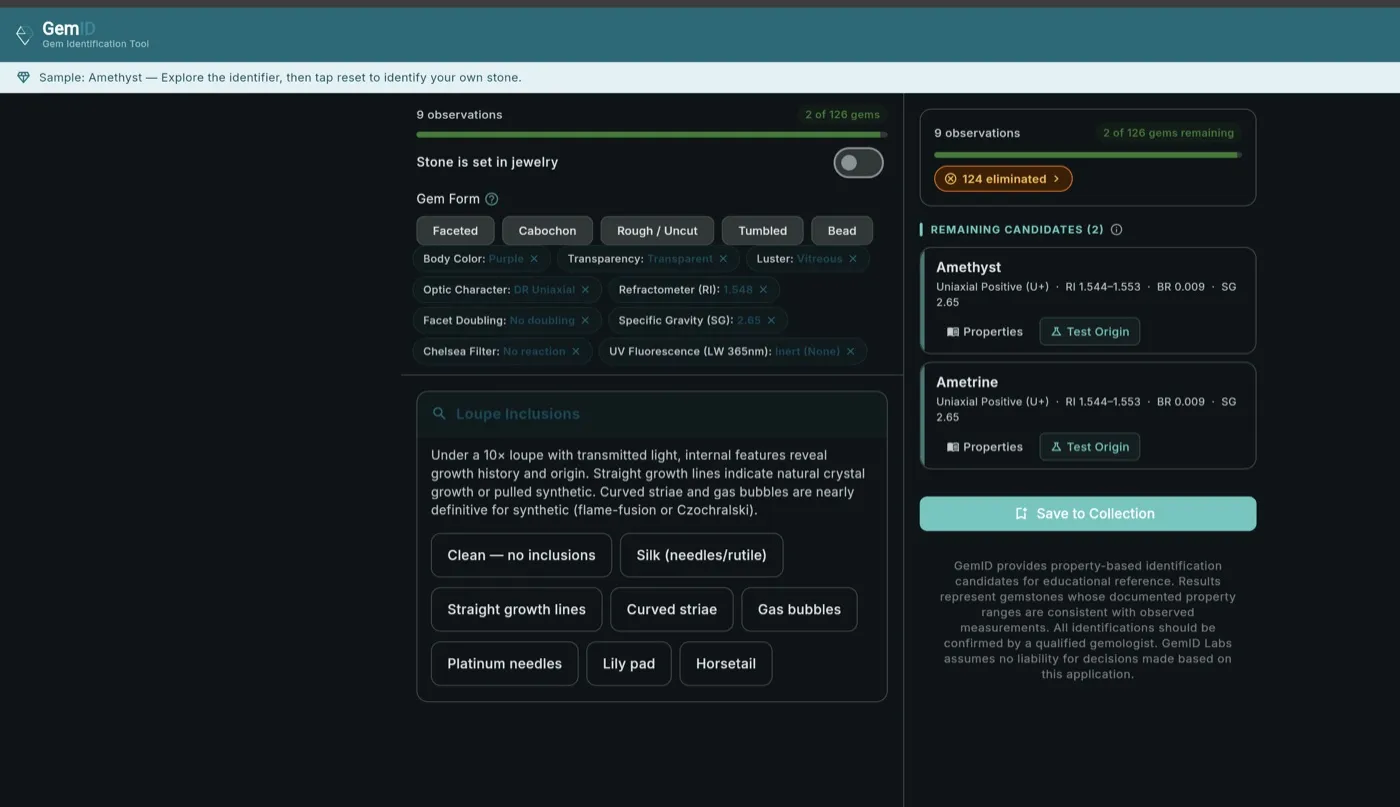
Start with what you can see — colour, lustre, whether light passes through the stone. Loupewise narrows 132 species to the genuine candidates, then tells you which test to reach for next. Bring a UV torch or a polarising filter and the list gets shorter still; you need neither to start. A photograph identifies nothing on its own; your phone, used as an instrument, does a great deal. Catalog your stones, generate examination reports, and practice for your exams with the same engine.
No credit card required. 7-day full Pro access.



What’s on the site
Everything here is free to read, no account needed. The measurements behind the app, published as reference.

Property charts
13 charts · sortable
Refractive index, specific gravity, hardness, fluorescence, pleochroism and more — every species in one sortable table per property. Ruby and sapphire share an RI of 1.762–1.770; the charts show what does separate them.
Browse the charts →
The gem database
132 species · 48 data points each
One page per species — refractive index, specific gravity, hardness, optic character and the rest — what it is confused with, and the test that separates them.
Open a species page →
Instrument guides
16 guides · technique and limits
How to take each reading — refractometer, specific gravity, polariscope, spectroscope — what each instrument cannot settle, and which measurement is worth buying first.
Read the guides →
Look-alike comparisons
27 pairs · look-alikes and synthetics
The stones people actually confuse — ruby and spinel, natural and synthetic — side by side, with the reading that tells them apart.
Compare stones →
The identification app
16 input categories · free tier, no card
Enter what you measured; the candidate list narrows and tells you which test earns the most next.
Open the app →
Exam study guides
3 credentials · worked practical
What the GIA 20-Stone Practical, the Gem-A FGA Diploma and the FEEG European Gemmologist practical actually ask for, and a full worked example from first reading to written conclusion.
See the study guides →Three steps to a confident identification
The exact methodology the GIA, Gem-A, and FEEG exams test you on — systematic measurement, narrowing the candidate list, and following test recommendations under time pressure. Covers 132 species, 48 data points per gem.

Enter your measurements
Start with just a refractive index reading. That takes 132 candidates to a median of 15 — fewer at an unusual value, up to 32 where the scale is crowded. Each additional measurement narrows further.
Loupewise ranks candidates
The identification engine filters all 132 species against your measurements, flags inconsistencies, and surfaces the most likely identifications with explanations.
Follow guided next tests
Loupewise recommends the highest-value test to run next — the one that will narrow candidates most efficiently — and explains what result to look for.
What Loupewise tests
16 instrument and observation categories. Use any combination — Loupewise narrows candidates with whatever you have.
Beyond identification: two-phase origin and treatment testing for 41 gem species, guided step by step with the decision logic at each branch.
What data does Loupewise have for each gem? ▼
How does the candidate ranking work? ▼
Can I use Loupewise with only one or two measurements? ▼
Plans start free
Every account includes a 7-day Pro trial. No credit card required, and the free tier keeps full instrument input on all 132 species and the complete candidate list. See plans and pricing →
Common questions
Can an app really identify gemstones without a photo? ▼
Are these the actual GIA, Gem-A, or FEEG exam questions? ▼
Is Loupewise a substitute for a gemologist? ▼
What happens after the 7-day trial? ▼
What's the difference between Hobbyist and Pro? ▼
Does Loupewise replace a lab report? ▼
Get in touch
Bug report, feature idea, or API access question — we read everything.